
Anatomy of an answer
How chips are manufactured, and the one machine in the process that Europe controls.
Chip fabrication
Europe’s fabs in Dresden, Grenoble, Catania and Villach are competitive in what they do: power semiconductors, automotive and industrial chips, sensors. That reflects the customers on the continent — carmakers and industrial groups rather than smartphone or AI-chip designers.
Two projects illustrate how Europe’s manufacturing capacity now depends on decisions taken elsewhere. ESMC in Dresden is TSMC’s first European plant, a joint venture with Bosch, Infineon and NXP costing around €10bn with roughly half from German state aid, due to start production about 2027. Its output is aimed at the automotive and industrial market rather than the frontier, so it strengthens the sector Europe already has instead of creating a new one. Intel’s Magdeburg project was the opposite bet: some €30bn with about €10bn in German subsidy, announced in 2022 as Europe’s entry into advanced logic. Intel delayed it in 2024 and then dropped it as its own finances deteriorated. The Chips Act had committed public money to it, but the investment decision was Intel’s to make — which is the structural problem with a strategy that relies on attracting foreign manufacturers.
What’s being done: the EU Chips Act is generally credited with having created momentum where there was none. Its research pillar is well regarded: pilot lines, the strengthening of imec (the Belgian interuniversity microelectronics research centre in Leuven, one of the few places outside a chipmaker where next-generation processes are developed), competence centres and design access for smaller firms are widely seen as sound uses of public money, and seven first-of-a-kind manufacturing projects have been approved. The criticism concerns scale and design. The European Court of Auditors concluded in April 2025 that the Act is “very unlikely” to reach the 20% target, calling it “essentially aspirational” and noting it would require roughly quadrupling European capacity by 2030. Of the €86bn estimated to flow from the Act by 2030, the Commission directly controls only €4.5bn — about 5% — with the rest coming from member states and industry, which the auditors found fragmented and hard to steer. For comparison, the largest global chipmakers budgeted around €405bn over three years alone. The Commission’s own forecast puts the EU at 11.7% of global production value by 2030, against 9.8% in 2022. Discussion of a revised Chips Act is under way, and the auditors’ main recommendation was to set targets that can actually be measured and met.
The EU targets 20% of global chip production value by 2030. The Commission’s own projection is 11.7%, and the European Court of Auditors judges even that to be the realistic ceiling on current commitments. Europe’s fabs are likely to remain strong in automotive and industrial chips and absent from the leading edge.
Lithography
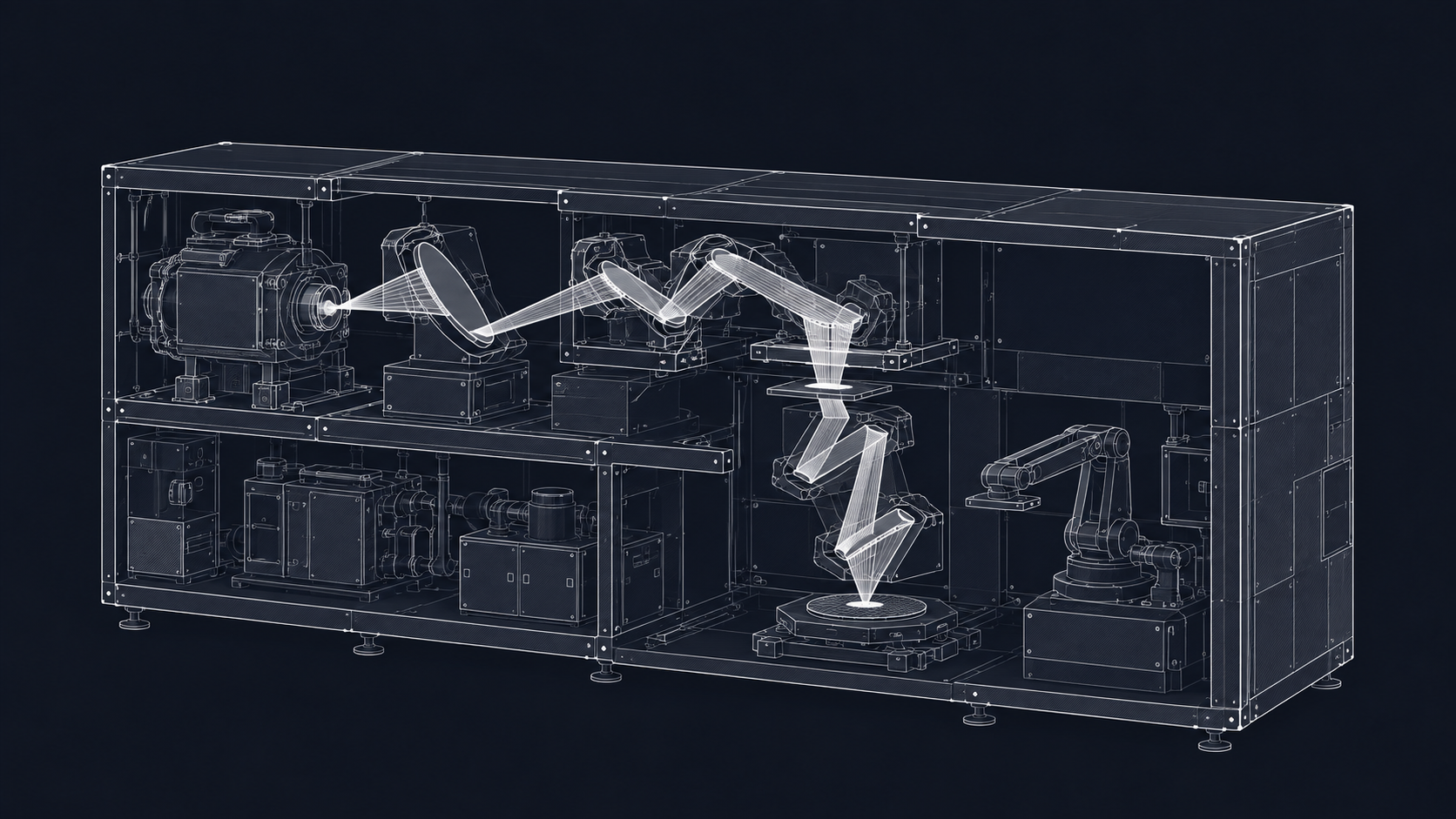
This is the AI supply chain's clearest European chokepoint — and it is already being used as one: at Washington's urging, the Dutch government restricts EUV exports to China, which is why Chinese chipmakers remain generations behind at the leading edge. Useful to know: ASML's monopoly rests on a 30-year, multi-country R&D bet others abandoned — and on a supplier network of ~5,000 firms, mostly European.
Owning the machine and using it are different things, and this is where the two layers of this part meet. Europe’s monopoly sits on the supply side: it builds the tool that every advanced fab needs. The demand side is the previous layer — the fabs themselves — and Europe has almost none at the leading edge. The consequence became explicit in September 2026, when ASML said publicly that it sells none of its machines on its own continent.
“We are selling absolutely nothing in Europe. Because Europe is not investing and because no chip factories are being built in Europe.”
The figure behind the remark is stark. Europe accounted for 0% of ASML’s net system sales in both the first and second quarters of 2026, against 1% in 2025, 5% in 2024 and 4% in 2023. In the second quarter the company’s machines went to South Korea (43%), Taiwan (30%), China (14%), the United States (9%) and Japan (4%). Europe registered nothing. No fab on the continent currently runs EUV production at all.
This is the clearest evidence available on whether the Chips Act is working as intended. Europe holds a monopoly on the machine that every advanced chip must pass through, and sells none of them at home, because the factories that would buy them are not being built. Heemskerk added that the United States, China and India are all pressing ASML to expand research and production on their territory: a quarter of the company’s research is already done in the US, and Washington has asked for half. A chokepoint is only leverage while the company holding it has a reason to stay.
How durable is it? Less durable than the 100% figure suggests. ASML’s China sales — for older non-EUV systems — have been a large share of revenue and are being squeezed by successive Dutch and US export controls, which also give Beijing a strong incentive to build an alternative: SiCarrier, SMEE and Huawei-linked programmes are all working on domestic lithography, and Chinese researchers have published on alternative EUV source designs. Canon is pursuing nanoimprint lithography as a route that sidesteps EUV entirely. None of these is close today, and the mirror supply chain through Zeiss is itself a chokepoint others would have to reproduce — but monopolies in this industry have historically lasted a technology generation or two, not indefinitely. Nikon and Canon led lithography before ASML did.
Every advanced chip is printed on a machine built in the Netherlands, and export licences for those machines are issued in The Hague. The position is real, but it depends on a single company, a single optics supplier, continued alignment with Washington on export policy — and on that company continuing to see a reason to stay in Europe, which sells none of its machines.
The refined minerals the hardware is built from, and the electricity it runs on.
Coming soon.