Europe leads the science and supplies the parts. The Quantum Act is its first attempt to own the industry too.
On 25 November, in Strasbourg, the European Commission proposed the Quantum Act: the EU’s first law written specifically for quantum technology. Beside it came the Sovereign Tech Equity Fund, a vehicle worth up to €50 billion, so that Europe can take stakes in its own strategic companies instead of watching them leave.
The Draghi report put quantum’s possible contribution to the European economy at up to €850 billion over 15 to 30 years. Virkkunen’s summary of the European problem was blunter: “We attract 5% of global private funding, against 50% in the US.“
This is a proposal, not a law: Parliament and the member states will negotiate it for the next two years. It matters now all the same. For once the EU is legislating for a technology where Europe starts in front, and the money behind it will be settled long before the text is.
What quantum technology actually does
A normal computer stores information in bits, each either 0 or 1, and it works through possibilities one at a time.
A quantum computer uses qubits, which can be 0 and 1 at the same time. A set of qubits can hold an enormous number of possible answers at once, and a good quantum program makes the wrong ones cancel out so the right one stands out. For a few problems — simulating molecules, searching vast sets of options, breaking certain codes — that turns centuries into minutes. For ordinary computing it does nothing at all.
The catch is fragility. A qubit keeps its state only while nothing disturbs it, so heat, vibration or a stray magnetic field ruins the calculation. Progress is therefore counted in error-corrected, or “logical”, qubits: many physical qubits behaving as one reliable one.
The Act covers three applications of quantum technologies:
- Computing and simulation. The most valuable use is chemistry: modelling molecules and materials as they really behave. Better batteries, new drug candidates, and cheaper ways to make fertiliser, whose main ingredient, ammonia, consumes about 2% of the world’s energy.
- Communication. The key travels as single particles of light, and reading them changes them, so both ends can tell that someone listened.
- Sensing and metrology. The least discussed and the closest to use: clocks, gravimeters and inertial sensors precise enough to navigate without GPS, map what lies underground, or detect a submarine. The defence applications are equally crucial for Europe’s security debate.
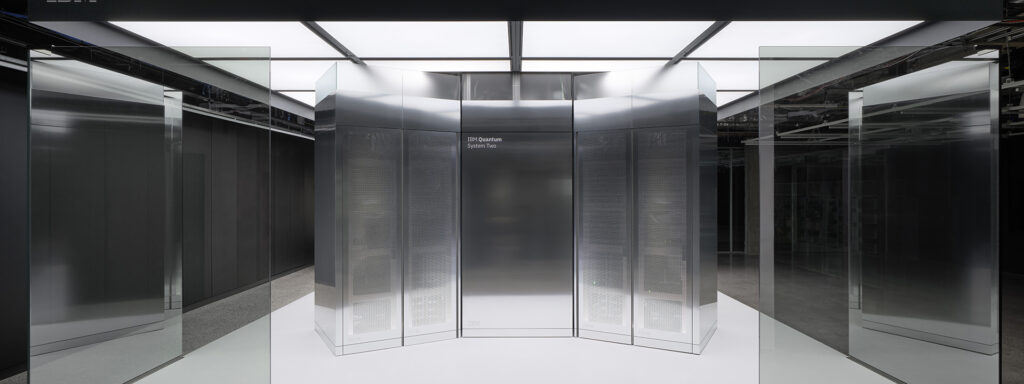
Where the hardware stands: in July 2026, IBM and the University of Chicago ran a calculation on 70 error-corrected qubits in about fifteen minutes that classical methods could not have finished in any useful time. Real progress, and still far from a machine a company would rent to design a medicine.
The competition is over who owns these machines when they finally work.
The deadline to replace encryption
One consequence of quantum technologies cannot wait for the hardware. Almost all encryption in use today — banking, hospital records, government cables, the messages on your phone — rests on mathematics a large quantum computer could eventually undo. No machine can do that yet, but two things make the deadline real. Encrypted traffic can be collected today and stored until a machine exists to open it — the Commission says such “store now, decrypt later” collection is already likely happening — so anything that must stay secret for a decade is exposed now. And swapping the cryptography out across banks, hospitals and grids takes years of engineering.
The answer is post-quantum cryptography: algorithms built to withstand quantum attack. Member states agreed a timetable in June 2025: national roadmaps by the end of 2026, critical infrastructure migrated by the end of 2030, the rest by 2035. Six months after it takes effect, public administrations covered by the EU’s cybersecurity law will only be able to buy quantum-safe products for critical systems, and the Commission can impose binding milestones on governments that fall behind.
Where Europe actually stands
The Commission’s counts 32% of the world’s quantum companies in the EU, against roughly 25% in the United States and 5% in China.
The EU and its member states have put over €11 billion of public money into the field in five years; European governments have announced €8.6 billion against €5.3 billion in the United States.
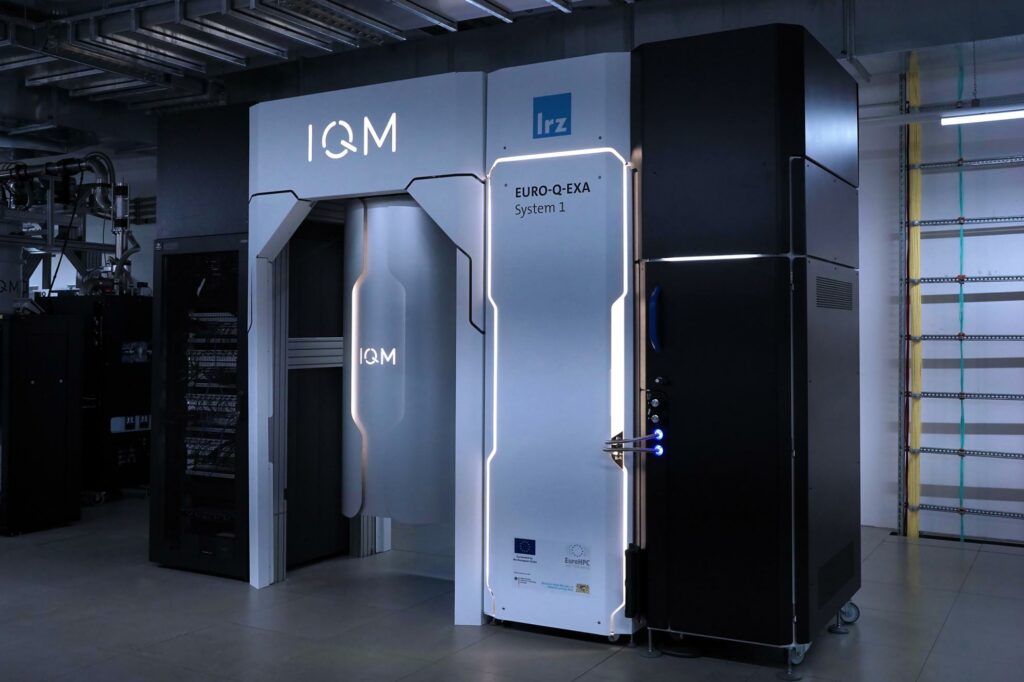
Ten quantum machines are going in at EuroHPC supercomputing sites across eight countries, which makes Europe’s public computing centres the industry’s biggest customer. Eagle-1, Europe’s first quantum-encryption satellite, is due to launch in late 2027.
Quantum technology: shares of global totals
EU share of each measure, against the rest of the world
Each bar totals 100%. Parts: EU vendors supply "nearly half" of the hardware and software components used in quantum computers, shown here as 50%. For reference, within the rest of the world the United States holds 23% of quantum patents and China 46%, and the United States takes more than half of global private quantum funding. Sources: European Commission Joint Research Centre, Future Directions for Quantum Technology in Europe, 2025; European Commission, Quantum Europe Strategy, July 2025.
Now the other side: European quantum companies raised €1.1 billion of private capital in 2025; American ones raised around €7 billion. Across the sector Europe takes about 5% of global private quantum investment, the United States more than half. And the EU holds 6% of the world’s quantum patents, against 46% for China and 23% for the US.
In Europe’s own patent office, European firms and labs hold under a third of quantum patents, with American ones in front. Europe’s quantum industry consortium warns its members could end up licensing technology in their own market. The Act mentions intellectual property once, as a condition it can attach when it admits a non-EU company.
Close to half the parts inside the world’s quantum computers are made in Europe, and the machines that set the records are built and sold by American firms. Europe supplies the stack and buys back the product.
What the Quantum Act does
The regulation builds a framework, it does not hand out money.
Three pillars — research excellence, getting the technology used, keeping systems and supplies secure — run through a new Quantum Europe Framework Initiative that pulls national programmes under shared priorities. The Act would:
Two advisory bodies sit on top: a member-state Quantum Strategy Board and a European Quantum Alliance for industry.
The money question
The Commission’s impact assessment puts the programme’s needs at €12.9 to €18.1 billion over the same period, from the EU budget, national governments and private investors — all dependent on the next seven-year budget, still being fought over.
The Sovereign Tech Equity Fund is the ambitious piece. Public money from the EU, member states and the European Investment Bank would take stakes worth hundreds of millions in European quantum, AI, chip and cloud companies, pulling private capital in behind it. Virkkunen called €50 billion a sufficient starting target, and that €400 to €500 billion will be needed later. The Act names no figure: the fund is an option in the text, tied to the same budget negotiation.
Washington has done the same, taking minority stakes in nine quantum companies for about $2 billion.
Even at €50 billion, the fund leaves the bigger problem untouched. European savings leave the continent to finance American companies because Europe has 27 capital markets instead of one. Until governments merge those markets, Europe will keep building companies it cannot afford to keep.
Where quantum money would come from in the 2028–2034 EU budget
European Commission proposal, € billion, current prices. Total €1,985bn
No line in the budget is reserved for quantum. The money would come from two programmes inside the competitiveness heading: the €51.5 billion Digital Leadership window of the European Competitiveness Fund, which also covers artificial intelligence, semiconductors and computing, and the €175 billion Horizon Europe research programme. Together they are 11% of the proposed budget. The Quantum Act's impact assessment puts the quantum programme's own needs at €12.9 to €18.1 billion for the period — between 0.6% and 0.9% of the budget — shared between the EU budget, national governments and private investors. Both programmes sit in the heading the Council presidency proposes to cut hardest. Sources: European Commission, MFF 2028–2034 proposal and European Competitiveness Fund regulation, July 2025; Quantum Act impact assessment, November 2026; Council of the EU negotiating box, 10 October 2026.
The buy-European bet
The most contested clause decides who is let in. Strategic infrastructures, strategic projects, innovation hubs and public quantum contracts are reserved for “Union-controlled” entities: companies seated in the EU that no third country, foreign company or foreign national controls. The test is control rather than ownership, so a European start-up with foreign minority investors stays eligible, while the European subsidiary of a US or Chinese group does not. The restriction reaches subcontractors, and consortia need a majority of Union-controlled members.
There are three ways in. Firms from countries associated with EU programmes can take part where the agreement is reciprocal, and the Commission can authorise others case by case through strategic partnerships. Firms based in partner countries covered by the EU’s procurement commitments can also bid, subject to security exceptions. China is never named, but the security logic points there.
The harder test is closer to home: on 20 November the EU and the United Kingdom agreed a Digital Partnership covering quantum, to launch in early 2027, and several of Europe’s strongest quantum companies are British.
The trade-off cuts both ways. Reserving the market protects capability in technologies with direct military uses, and answers a fear European governments now take seriously: whoever supplies a critical system can switch it off.
What decides whether this works
The budget
The negotiation on the EU's 2028–2034 finances, not this regulation, settles whether the Framework Initiative and the equity fund exist at any serious scale.
In negotiationThe capital markets
The deeper fix sits outside this law: the savings and investments union decides whether European firms can raise European money at scale.
Council position agreed, October 2026The authorisations
Which non-EU companies are let in, and how fast, will show whether “Union-controlled” is industrial policy or a wall.
Only after entry into forceThe implementation
National quantum strategies are due six months after entry into force, and national post-quantum cryptography roadmaps by the end of this year.
Roadmaps due end 2026Europe has spent two decades inventing what others scaled. None of this is a result yet: the Act decides who may build quantum technology here and who may buy it, and next year’s budget fight decides whether anyone can afford to.
- November 28, 2026
- The Europeans Admin
- 11:41 am