You have a great idea. Now what?
You have a concept, a co-founder in Warsaw, an engineer in Lisbon, and an angel investor in Amsterdam asking a simple question: where are you incorporated? The answer, today, is a mess.
Depending on where you set up, you face different rules, different costs, different timelines – and different levels of credibility with investors. Most founders end up chasing the path of least resistance: a UK Ltd, a Delaware Inc, or whatever their lawyer recommends. Not because it’s the right fit. Because Europe doesn’t offer a real alternative.
That, at least in theory, is what the European Commission is trying to fix.
What the Commission actually did
This didn’t come out of nowhere. After years of mounting pressure on Europe’s competitiveness deficit, two landmark reports crystallised the challenge.
Mario Draghi’s report on European competitiveness and Enrico Letta’s report on the future of the Single Market both flagged the same structural problem: Europe’s fragmented regulatory environment is holding back its most dynamic companies.
The calls for a common EU company law – a “28th regime” sitting alongside the 27 national systems -, also driven by the EU INC petition, became impossible to ignore.
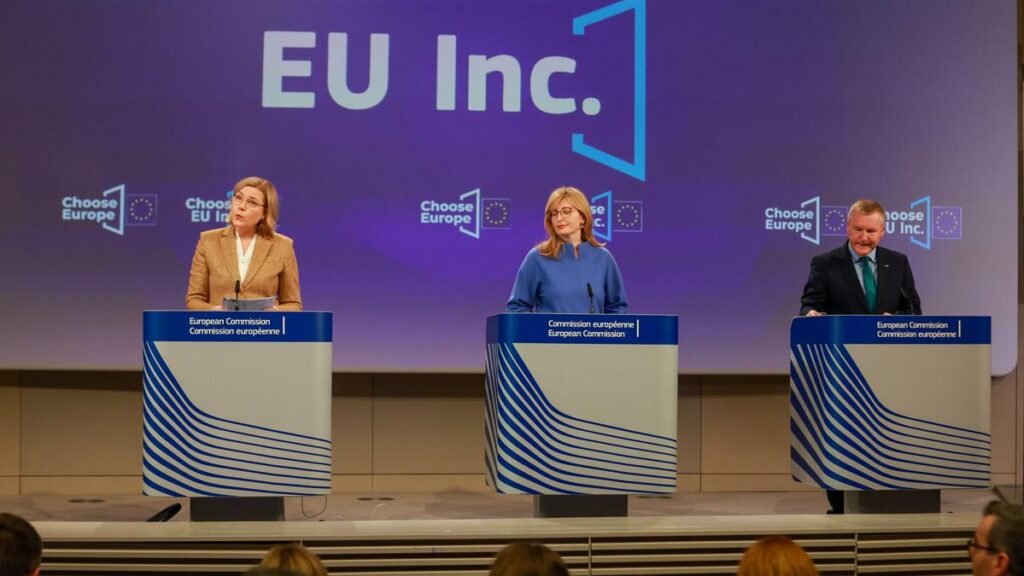
On 18 March 2025, the Commission delivered a new proposal to establish EU Inc.: an optional, EU-wide company form governed by harmonised EU rules. Here’s what it will introduce if adopted:
The choice of a Regulation – rather than a Directive, as some had advocated – is significant. It means the rules apply directly and uniformly across all 27 Member States, without passing through national parliaments that might water them down.
Why this is genuinely good news
Give credit where it’s due: the EU Inc. proposal addresses real, long-standing asks from Europe’s startup and investment community – and does so in a more binding way than previous attempts.
Think about what a Delaware Inc. offers a US founder: a single, standardised, investor-friendly legal vehicle that any American VC, angel or accelerator understands on sight. European founders have never had that. A French SAS, a German GmbH, a Polish sp. z o.o., each comes with its own legal logic, its own quirks, and critically, its own in-group of local investors who understand it.
The data is stark: cross-border venture capital investment in Europe remains limited – around 20-25% overall – with the majority of funding still domestic.
That in turn becomes a network problem: investors often bring connections, advisors, and follow-on funding. If you can only credibly access your domestic investor pool from day one, you’re competing with one hand tied behind your back, while your Delaware-incorporated competitor has a global network on speed dial.
EU Inc. was designed, at least in principle, to change this. A single, recognisable EU company form: one that any European investor, accelerator or legal team can evaluate without a national law primer, is the kind of structural fix that could shift early-stage dynamics in a meaningful way. On that ambition, the Commission deserves credit for moving.
Where it falls short – and it does fall short
The good news ends here. EU Inc. makes it easier to create a company in Europe. It does not make it meaningfully easier to scale one. Three structural gaps define the limits of this proposal.
First, tax remains entirely national. The proposal explicitly excludes corporate income taxation from its scope. Tax residence, profit allocation, withholding taxes on dividends, all still governed by 27 different national systems. A company incorporated as an EU Inc. in Brussels, hiring in Berlin, selling in Barcelona, still faces three separate tax environments. The ESOP harmonisation is welcome, but it is a footnote, not a solution.
Second, labour law is untouched. The Commission confirmed at launch that the Regulation does not affect existing EU or national labour frameworks. Cross-border hiring, employment contracts, social contributions, termination rules: still fragmented. For a fast-growing company trying to build a distributed European team, the incorporation form changes nothing about the operational complexity of employment.
Third – and most structurally important – there is no single jurisdiction. EU Inc. does not create a unified EU legal space. Courts, insolvency procedures, and the interpretation of corporate rules remain national. Legal predictability, one of the most critical factors for investors evaluating risk, still depends on domestic courts and administrative practices. Previous EU-level company forms – the Societas Europaea (SE) and the Societas Cooperativa Europaea (SCE) – are largely unused precisely because they never resolved this problem. EU Inc. risks repeating the pattern.
A true 28th regime could have been transformative not only for high-growth tech companies, but for the millions of established SMEs across Europe that want to operate across borders without drowning in compliance.
Think of a Polish construction firm that has been operating in Germany for fifteen years, employing crews across both countries, filing paperwork in two languages under two legal systems – paying lawyers in both countries just to stay compliant. Or an Italian artisan food producer trying to open a second facility in Spain, spending months navigating incorporation rules that have nothing to do with whether their product is good.
For businesses like these, a genuinely harmonised EU legal environment would have meant one less lawyer to pay, less filing, less reasons not to expand.
The political read: Cautious by design
.

Why did the Commission stop here? Because it had to.
Corporate law sits at the intersection of tax, labour, courts, and governance – all areas where Member States guard their sovereignty closely. The history of EU-level company forms is a history of compromises: the SE exists on paper but is rarely used in practice; the SCE has barely registered. Each time, the proposal was ambitious in concept and diluted in execution.
This proposal was calibrated to survive that process: the choice of an optional regime – no Member State is forced to replace anything – and the explicit ring-fencing of tax and labour were political decisions. Member States’ broad support, confirmed by the Commission at the proposal’s launch, was purchased precisely because the proposal does not threaten national systems.
The legislative road ahead is long. Interinstitutional negotiations between the Commission, Council (Member States) and European Parliament are now beginning, with an agreement targeted by end of 2026.
Member of the European Parliament Pascal Canfin has already signalled he will lead negotiations in the Parliament for the Renew Europe party, and early reactions from MEPs across EPP and Renew suggest support for the proposal, paired with clear warnings that the current should be improved.
Whether that political window holds, and whether negotiations strengthen or weaken the proposal, remains entirely open.
The bottom line
If you’re a founder, an investor, or someone building something in Europe, here’s what to take from this:
EU Inc. is real progress. The 48-hour digital incorporation, the ESOP reform, the Regulation format, these are real changes. For the first time, Europe has a common company form that could become the default for entrepreneurs who want to compete on a continental scale.
But be clear-eyed about what it is: a building block, not a finished house.
The structural barriers to scaling in Europe – fragmented tax, fragmented labour, fragmented legal space – are still standing.
What comes next matters as much as this proposal.
EU Inc. is a starting gun and the real work starts now: in the Parliament committees, in the Council working groups, in the lobbying offices and founder communities that need to stay loud throughout negotiations.
The Commission provided a blueprint. Whether it becomes a true revolution for European business is up to all of us. At The Europeans, we intend to make sure it does. If you would like to contribute, reach out.
Published: 19/03/2026

Author: The Europeans Editor